

How to Find Buyers for Export: Complete Guide for Exporters
Finding international buyers is one of the biggest challenges exporters face. You may have a good product, competitive pricing, production capacity and the ability to ship internationally—but none of that matters if the right buyers cannot find you.
The good news is that finding export buyers does not depend on one website, one database or one trade show.
The most effective exporters build a buyer acquisition system that combines proactive research and outreach with a strong business presence that allows buyers to discover them.
This guide explains how to find buyers for export, how to identify genuine buyers, how to contact them, how to avoid wasting money on poor-quality leads, and how to build a repeatable system for generating international business.
Quick Answer: How Do You Find Buyers for Export?
There are two fundamental ways to find export buyers:
1. Go looking for buyers
You identify companies that already import, distribute, manufacture, wholesale or sell products like yours.
You can find them through:
Google
LinkedIn
Import and shipment data
B2B marketplaces
Trade associations
Chambers of commerce
Government export agencies
Embassies and commercial offices
Trade shows
Distributors and buying agents
Direct email and phone outreach
2. Build a business buyers can discover
Instead of relying entirely on outbound prospecting, you build an online presence that allows international buyers searching for your product to find your business.
This includes:
- A professional website
- Strong product pages
- SEO
- Content marketing
- Digital advertising
- Professional branding
- Online promotion
- Industry-specific visibility
The strongest export businesses generally combine both approaches.
You actively search for buyers while also building an asset that allows buyers to find you.
TASIQO’s approach is primarily focused on the second side of this equation: building visibility around exporters and their products so relevant buyers can discover them, while exporters can continue using outbound channels such as LinkedIn, trade shows and direct outreach.
Table of Contents
- Start by Defining the Buyer You Actually Want
- Build an Export-Ready Buyer Profile
- Use the Two-Part Export Buyer Acquisition System
- How to Find Buyers for Export: 12 Practical Methods
- SEO Can Turn Your Website Into a Buyer Acquisition Channel
- What Is the Best Way to Find Buyers for Export?
- How TASIQO Fits Into Export Buyer Acquisition
- A Real Example: Turning an Export Product Into a Discoverable Business
- How to Find Genuine Buyers for Export
- How to Verify an International Buyer
- Export Buyer Red Flags
- Why Exporters Don’t Get Responses From Buyers
- How to Find Export Buyers for Free
- When Should You Pay for Buyer-Finding?
- How Long Does It Take to Find an Export Buyer?
- How to Build a Repeatable Export Buyer Pipeline
- A Practical 30-Day Export Buyer-Finding Plan
- The Best Export Buyer Strategy Is Not One Strategy
- What Makes an Export Business Easy for Buyers to Trust?
- Don’t Confuse Visibility With Sales
- Frequently Asked Questions
- Final Thoughts: Build a System, Not a Buyer List
1. Start by Defining the Buyer You Actually Want
One of the biggest mistakes exporters make is searching for “international buyers” without defining what an ideal buyer actually looks like.
A buyer could be:
- An importer
- Distributor
- Wholesaler
- Retailer
- Manufacturer
- Private-label company
- Supermarket chain
- E-commerce company
- Buying agent
- Trading company
- Commercial food service company
These buyers don’t have the same requirements.
For example, a manufacturer looking for industrial components may buy directly from a factory, while a food exporter may need a distributor or importer with an established retail network.
Before searching, answer five questions.
What exactly are you exporting?
Be specific.
Instead of:
Food products
define:
Himalayan pink salt for foodservice and retail packaging.
Instead of:
Textiles
define:
Cotton knitted sweaters for private-label European retailers.
The more specific your product definition, the easier it becomes to identify appropriate buyers.
Determine Your HS Code
Your Harmonized System (HS) code helps categorize products in international trade.
It is particularly useful when researching trade statistics because you can investigate which countries import a particular product category and, depending on the data source, which companies participate in that trade.
Trade databases such as UN Comtrade allow users to explore trade flows by product classification, reporter, partner and period. (UN Comtrade)
Do not rely only on the product name people use commercially. Different countries and databases may classify products differently.
Choose Your Target Markets
Don’t start by saying:
“I want buyers from everywhere.”
Start with a smaller number of markets.
For example:
- UAE
- Saudi Arabia
- Germany
- United Kingdom
- United States
- Canada
- Australia
Then investigate which markets actually import your product.
Your target market should be based on factors such as:
- Import demand
- Competition
- Product regulations
- Certifications
- Tariffs and duties
- Shipping costs
- Market size
- Buyer concentration
- Your ability to serve the market
2. Build an Export-Ready Buyer Profile
Before contacting buyers, prepare the information they are likely to need.
At minimum, you should know:
- Product name
- Product specifications
- HS code
- MOQ
- Packaging
- Production capacity
- Lead time
- Available certifications
- Country of origin
- Port of shipment
- Incoterms
- Payment terms
- Product photographs
- Company information
- Website
- Contact details
You don’t necessarily need to send all of this in your first message.
But you should have it ready.
A buyer who responds with:
“Please send your specifications and MOQ.”
shouldn’t have to wait three days while you prepare the information.
3. Use the Two-Part Export Buyer Acquisition System
This is the most important concept in this guide.
There are two fundamentally different ways of generating export opportunities.
Method A: Find the Buyer
You identify a potential buyer and approach them.
You → Buyer
Examples:
- Google research
- Trade data
- Email outreach
- Trade shows
- Buyer databases
- Industry associations
This approach is proactive.
Method B: Become Discoverable
The buyer is already looking for a supplier, but instead of you finding them, they find you.
Buyer → You
Examples:
- Google Search
- SEO
- Product pages
- Content
- Branding
- Digital marketing
- B2B visibility
- Online promotion
This approach is inbound.
Why You Should Combine Both
Imagine two exporters selling the same product.
Exporter A spends every week searching for new buyers.
Exporter B searches for buyers too, but also builds a website and online presence that generates inquiries from buyers who discover the company independently.
Exporter B is building an additional acquisition channel.
That is the fundamental difference between finding buyers and building a business that buyers can find.
4. How to Find Buyers for Export: 12 Practical Methods
Now let’s look at the actual methods.
4.1 Find Buyers Using Google
Google is one of the simplest ways to identify potential importers, distributors and wholesalers.
Don’t search only for:
product + buyer
Use different combinations.
For example:
pink salt importer UAEsalt distributor Dubaiorganic spice importer Germanycotton sweater wholesaler UKsportswear distributor Australialeather goods importer Canada
You can also search for industry terminology:
- importer
- distributor
- wholesaler
- procurement
- sourcing
- purchasing
- private label
- supplier
- buying office
Go beyond the first page
Once you identify a company, investigate:
- Its website
- Product range
- Countries served
- Existing suppliers
- Contact information
- Decision-makers
- LinkedIn profiles
- Purchasing requirements
Google is not simply a way to find a buyer’s email address.
It is a research tool for understanding the market.
4.2 Use Import and Shipment Data
One of the strongest ways to identify potential export buyers is to find companies that are already importing products similar to yours.
This changes the question from:
“Who might want my product?”
to:
“Who is already buying this type of product?”
That distinction matters.
Trade data can help you investigate:
- Importing countries
- Import volumes
- Trading partners
- Product categories
- Importers
- Suppliers
- Historical trade flows
UN Comtrade provides international trade data that can be filtered by product classification, country and trade flow. (UN Comtrade)
Commercial shipment-data providers can provide more granular company-level information in some markets.
A practical workflow
Step 1: Identify your HS code.
Step 2: Find countries importing significant quantities.
Step 3: Select the most attractive markets.
Step 4: Identify companies importing the product.
Step 5: Research those companies.
Step 6: Find the appropriate purchasing or sourcing contact.
Step 7: Approach them with a relevant offer.
The objective isn’t to send the same message to 500 companies.
It is to build a list of relevant companies.
4.3 Use LinkedIn to Find International Buyers
LinkedIn is particularly useful for B2B exports because you’re able to search for both:
Companies
and
People.
Instead of searching only for:
buyers
search for job titles such as:
- Import Manager
- Purchasing Manager
- Procurement Manager
- Sourcing Manager
- Purchasing Director
- Procurement Director
- Category Manager
- Supply Chain Manager
- Managing Director
- Owner
Then combine the job title with:
- industry
- country
- company size
- product category
For example:
Procurement Manager + food distribution + UAE
or:
Purchasing Manager + sportswear + United Kingdom
Don't use LinkedIn only for outreach
There is another important reason to maintain a strong LinkedIn presence.
When you contact a potential buyer, they may search for your company.
Your LinkedIn profile becomes part of your credibility.
Show evidence such as:
- Factory photographs
- Production videos
- Product launches
- Quality-control processes
- Certifications
- Packaging
- Container loading
- Export markets
- Customer testimonials
A buyer should be able to see evidence that you are a real operating business.
4.4 Use B2B Marketplaces
B2B marketplaces can provide access to buyers already looking for suppliers.
Examples include platforms such as Alibaba and other industry or country-specific marketplaces.
They can be useful because they already have an established audience of buyers.
But there is an important limitation:
Listing a product does not automatically create a successful export business.
You are competing against many suppliers.
Your listing needs:
- Professional photography
- Accurate specifications
- Clear MOQ
- Packaging information
- Certifications
- Production information
- Strong company profile
- Fast responses
- Clear communication
A marketplace should therefore be viewed as one acquisition channel, not your entire export strategy.
4.5 Use Government Export Promotion Agencies
Many exporters overlook their own government’s export-support infrastructure.
Government trade agencies may provide:
- Export training
- Market information
- Trade missions
- Buyer introductions
- Trade events
- Export directories
- Regulatory information
- Market research
For example, the U.S. Commercial Service provides several tools for exporters, including international partner searches, trade shows, trade missions, due diligence resources and matchmaking services. (Trade.gov)
Look for the equivalent organization in your country.
4.6 Find Buyers Through Trade Associations
Trade associations can be extremely valuable because they bring together companies within a specific industry.
Instead of searching for:
buyers of leather products
search for:
leather goods association Germany
or:
footwear distributors association UAE
or:
food importers association Australia
The association itself may not buy your product.
But its members may include the companies you want to reach.
This approach is especially useful for niche products.
4.7 Use Chambers of Commerce
Chambers of commerce can help you understand a local business market and identify companies operating in particular sectors.
Look for:
- National chambers
- Local chambers
- Bilateral chambers
- Industry chambers
- Business councils
For example, if you want to enter a particular market, research both the country’s local chamber network and organizations connecting your country with that market.
A referral from a credible business organization can sometimes be more useful than sending hundreds of generic emails.
4.8 Use Embassies and Commercial Offices
Embassies and commercial offices can also be useful when entering unfamiliar markets.
Look for:
- Commercial sections
- Trade offices
- Economic sections
- Business councils
- Trade promotion programs
These organizations may provide market information or point exporters toward relevant business resources.
Government-supported buyer-search programs can also provide more structured assistance. The U.S. Commercial Service, for example, offers International Partner Search and Gold Key matchmaking services. (Trade.gov)
4.9 Attend International Trade Shows
Trade shows remain valuable because buyers attend specifically to discover products, suppliers and business opportunities.
But don’t make the mistake of waiting until the event to start your buyer search.
Research exhibitors before the event.
Create a list of companies that:
- Import your product
- Distribute your product
- Could use your product
- Operate in your target market
Then contact selected companies before the show.
Instead of:
“We are attending the exhibition. Please visit our booth.”
you can say:
“We noticed your company distributes [product] in [market]. We manufacture [product] and will be exhibiting at [event]. Would you be available for a short meeting during the show?”
Now the trade show becomes a scheduled business-development opportunity, rather than a three-day hope that someone walks into your booth.
4.10 Find Distributors, Wholesalers and Buying Agents
Not every exporter should sell directly to the final customer.
Depending on your product, a distributor may already have:
- Warehouses
- Retail relationships
- Sales teams
- Local knowledge
- Existing customers
- Import infrastructure
For some products, finding a good distributor can therefore be more valuable than finding hundreds of individual retailers.
Search for:
[product] distributor [country]
[product] wholesaler [city]
[product] importer [country]
[product] buying agent [country]
Then evaluate the company carefully before entering an agreement.
4.11 Use Direct Email Outreach
Once you have identified a suitable buyer, you can contact them directly.
The biggest mistake is sending a generic message such as:
Dear Sir/Madam,
We are a leading manufacturer and exporter of high-quality products. Please find attached our catalogue.
Buyers receive messages like this constantly.
A better email is short and relevant.
Example export buyer email
Subject: [Product] supplier for [Company]
Hi [Name],
I came across [Company] while researching [product category] distributors/importers in [country].
We manufacture/export [specific product] from [country].
A few details:
- MOQ: [quantity]
- Packaging: [type]
- Certifications: [certifications]
- Production capacity: [capacity]
- Shipping terms: [FOB/CIF/etc.]
If you’re currently sourcing this product, I’d be happy to send specifications and pricing.
Would this be relevant to your current sourcing requirements?
Best regards,
[Name]
[Company]
[Website]
[Email]
[WhatsApp/Phone]
The objective of the first email isn’t necessarily to close a sale.
It is to start a relevant conversation.
4.12 Build a Website That International Buyers Can Find
This is one of the most overlooked export buyer-acquisition strategies.
Most exporters think of their website as a digital brochure.
It can be much more valuable than that.
Imagine a buyer searches Google for:
wholesale pink salt supplier
and discovers your website.
They read about:
- Your products
- Your company
- Your production
- Your certifications
- Your packaging
- Your export markets
Then they contact you directly.
You didn’t have to identify that buyer beforehand.
The buyer found you.
That’s the power of search visibility.
5. SEO Can Turn Your Website Into a Buyer Acquisition Channel
SEO isn’t simply about getting website traffic.
For an exporter, the goal is to attract commercially relevant searches.
Instead of targeting broad terms such as:
salt
you might target:
pink salt supplier
Himalayan pink salt bulk supplier
private label pink salt manufacturer
pink salt importer supplier
The exact opportunities depend on your product and market.
A strong export website should have dedicated pages for:
- Products
- Product specifications
- Applications
- Industries
- Certifications
- Packaging
- Export markets
- About the company
- Contact/inquiry
And importantly, the website should make it extremely easy for a buyer to contact you.
6. What Is the Best Way to Find Buyers for Export?
There is no single best method for every exporter.
The right combination depends on:
- Product
- Target market
- Budget
- Experience
- Order size
- Sales cycle
- Competition
- Regulatory requirements
Here is a useful comparison:
| Method | Cost | Speed | Buyer Intent | Scalability | Exporter Effort |
|---|---|---|---|---|---|
| Google research | Free | Medium | Medium | High | Medium |
| Free/Paid | Medium | High | High | High | |
| Import data | Free/Paid | High | Very High | High | Medium |
| B2B marketplaces | Free/Paid | Medium | High | High | Medium–High |
| Trade shows | High | Medium | High | Low–Medium | High |
| Direct outreach | Low–Medium | Medium | High | High | High |
| Website + SEO | Medium | Slow | High | Very High | Medium–High |
| Government programs | Low–Medium | Medium | High | Medium | Medium |
| Distributors | Medium | Medium | High | Medium | Medium |
| Managed export marketing | Service cost | Builds over time | High | High | Lower for exporter |
The key isn’t necessarily choosing one.
It’s building a combination that works together.
7. How TASIQO Fits Into Export Buyer Acquisition
Some exporters have the time and internal resources to handle:
- Market research
- Branding
- Website development
- SEO
- Content creation
- Advertising
- Buyer research
- Lead generation
- Digital promotion
Others don’t.
That is where a managed export marketing approach can make sense.
TASIQO helps exporters and manufacturers become more discoverable to international buyers by combining marketing, SEO, lead generation, buyer research, advertising, direct promotion, branding and content.
The important distinction is that TASIQO is not an export marketplace or simply a directory of exporters.
The objective is to actively build and market the export business.
A typical process looks more like:
Exporter
↓
Product + market information
↓
Branding / positioning
↓
Website / online presence
↓
Content + SEO + marketing
↓
Buyer discovers the business
↓
Buyer contacts exporter
The inquiry goes directly to the exporter.
TASIQO is not the trader, broker or commission agent in the transaction.
8. A Real Example: Turning an Export Product Into a Discoverable Business
One of the clearest examples of this approach is the work TASIQO did with Skarf Enterprises, a company interested in exporting Pakistani pink salt.
Instead of simply placing the company into a database and waiting for a buyer, TASIQO developed the The Salt brand concept and built an online presence around it.
The product was then actively marketed through digital channels, including SEO, content, promotion and other buyer-acquisition activities.
Within a few months, international business inquiries began arriving.
The business now receives approximately 4–5 international business leads per month.
The important lesson isn’t that every exporter will receive exactly the same number of inquiries.
It is that an exporter can create an asset that continues working after the initial prospecting activity.
Instead of asking only:
“Who can I contact today?”
the exporter can also build:
“How can buyers looking for this product discover me?”
That is a fundamentally different approach to export marketing.
The result illustrates the difference between simply putting an exporter on a list and actively building visibility around an export business.
9. How to Find Genuine Buyers for Export
Finding a potential buyer is only the beginning.
You also need to determine whether the company is legitimate and commercially suitable.
Before committing to a large transaction, investigate the buyer.
Check the company
Look for:
- Legal company name
- Company registration
- Physical address
- Website
- Corporate email
- Telephone number
- Management information
- LinkedIn presence
- Industry presence
Check the buyer's business
Ask:
- What products do they currently import?
- Which markets do they serve?
- Do they already buy your product?
- Who are their customers?
- What quantity do they normally purchase?
- What specifications do they require?
A company can be completely legitimate and still be a bad prospect for your business.
10. How to Verify an International Buyer
Government export resources emphasize the importance of due diligence before international transactions. The U.S. Commercial Service, for example, provides resources specifically designed to help exporters manage risk and investigate foreign companies. (Trade.gov)
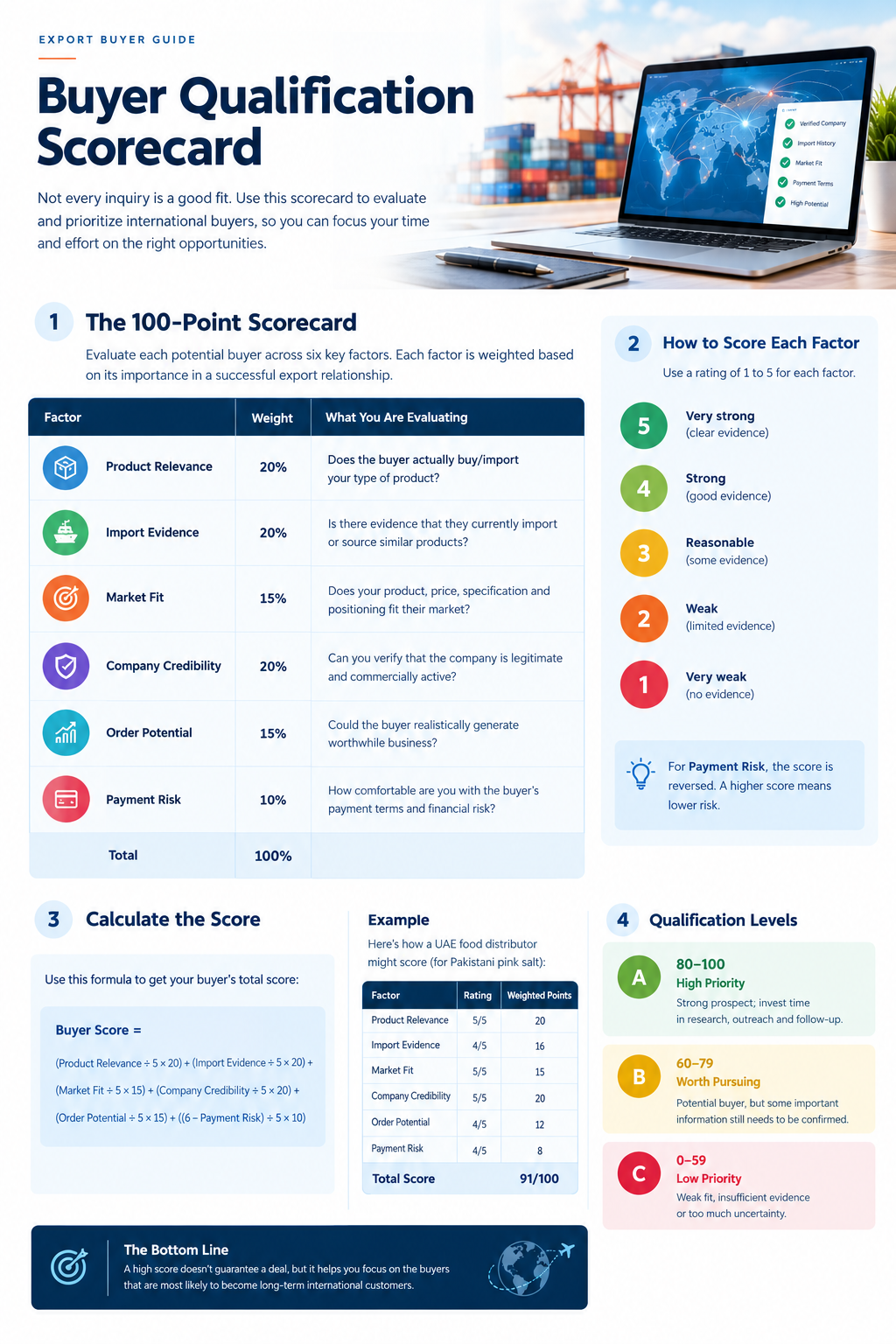
Use a layered verification process.
1. Verify the company
Check the appropriate government or corporate registry where available.
2. Verify the website
Look for:
- Real company information
- Physical address
- Telephone number
- Employees
- Products
- Management
- Business history
3. Verify the email
A corporate domain is generally more reassuring than a completely generic address, although the presence of a company domain by itself does not prove legitimacy.
4. Check trade history
Where reliable trade data is available, see whether the company actually participates in the type of trade it claims.
5. Request references when appropriate
For significant transactions, commercial references can be useful.
6. Consider payment risk
Payment terms should be evaluated according to the transaction, buyer, country and risk involved.
7. Start appropriately
For a new relationship, a manageable first transaction can reduce exposure while both parties establish trust.
Never assume that a large purchase order automatically means you have found a genuine buyer.
11. Export Buyer Red Flags
Be cautious when a potential buyer:
- Refuses to provide basic company information
- Uses suspicious or inconsistent contact details
- Makes unusually large demands without normal commercial discussion
- Pressures you to pay unexplained fees
- Wants unusual payment arrangements
- Provides inconsistent company information
- Refuses reasonable verification
- Requests sensitive information unrelated to the transaction
At the same time, don’t reject a buyer simply because they use a free email address or have a small website.
A red flag is a reason to investigate further, not automatically proof of fraud.
12. Why Exporters Don't Get Responses From Buyers
Many exporters conclude:
“There are no buyers for my product.”
Often that isn’t the real problem.
The problem is the approach.
Problem 1: Generic outreach
“Dear Sir, we are a leading exporter…”
doesn’t give the buyer a reason to respond.
Problem 2: Talking only about yourself
The buyer wants to know:
Why is this relevant to me?
Your message should demonstrate that you’ve researched them.
Problem 3: Poor online presence
If a buyer receives your email and searches your company, what do they find?
If they see:
- An outdated website
- No product information
- Poor photographs
- No company details
- No certifications
- No evidence of production
they may move on.
Problem 4: No follow-up
One email isn’t a buyer acquisition system.
A buyer may be:
- Travelling
- Busy
- Reviewing suppliers later
- Waiting for purchasing approval
- Interested but not ready
Follow up professionally rather than assuming silence means rejection.
Problem 5: Targeting the wrong companies
A list of 1,000 irrelevant companies is less valuable than 50 highly relevant prospects.
Relevance beats volume.
13. How to Find Export Buyers for Free
You don’t need an expensive database to begin.
A low-budget approach can combine:
Research importers, distributors and wholesalers.
Find companies and decision-makers.
TASIQO
Exporters who are not ready to invest in active marketing can also start by making their company easier to discover and keeping their information available to potential buyers. TASIQO offers a free exporter listing as an entry point.
Trade associations
Identify industry participants.
Government resources
Use export agencies and trade promotion organizations.
Trade-show exhibitor lists
Find companies already active in your industry.
SEO
Build long-term organic visibility.
Direct outreach
Contact relevant companies personally.
The downside is that free methods generally require more of your own time.
So the real question isn’t simply:
“Can I find buyers for free?”
It is:
“Do I have the time and skills to perform the buyer research and marketing myself?”
14. When Should You Pay for Buyer-Finding?
Paying for buyer acquisition isn’t automatically good or bad.
It depends on what you’re paying for.
Be careful with services promising:
“Guaranteed international buyers.”
or:
“10,000 verified buyers for $99.”
A huge database isn’t necessarily useful.
Consider paying for things that create genuine commercial value, such as:
- High-quality trade data
- Market research
- Professional SEO
- Content creation
- Digital advertising
- Trade shows
- Buyer research
- Professional branding
- Lead generation
- Managed export marketing
The objective should be to build a repeatable acquisition channel, not simply purchase a spreadsheet.
Paying for buyer acquisition makes more sense when you have a product with a clear market, competitive pricing, export capability and the ability to respond professionally to international inquiries.
At that point, a managed approach such as TASIQO’s premium exporter service can be considered alongside your own outbound activities.
15. How Long Does It Take to Find an Export Buyer?
There is no universal answer.
A buyer might respond to a cold email quickly.
Another opportunity may take months.
The timeline depends on:
- Product
- Market
- Buyer
- Order size
- Regulations
- Certifications
- Sales cycle
- Pricing
- Competition
- Relationship
More importantly, distinguish between:
Lead
Qualified opportunity
Sample request
Quotation
Negotiation
First order
Repeat customer
These are different stages.
An exporter who receives 20 inquiries but never qualifies them may actually be performing worse than an exporter receiving five highly relevant inquiries.
16. How to Build a Repeatable Export Buyer Pipeline
The ultimate goal isn’t to find one buyer.
It’s to build a system.
A basic export buyer pipeline looks like this:
Step 1 — Market research
Identify attractive countries.
↓
Step 2 — Buyer research
Find relevant companies.
↓
Step 3 — Qualification
Determine which companies are actually worth approaching.
↓
Step 4 — Outreach
Email, LinkedIn, telephone, trade shows or introductions.
↓
Step 5 — Follow-up
Continue the conversation professionally.
↓
Step 6 — Qualification
Determine:
→ Product requirement
→ Quantity
→ Target price
→ Specifications
→ Timeline
→ Market
→Payment expectations
↓
Step 7 — Proposal / quotation
Provide the information requested.
↓
Step 8 — Sample / testing
Where appropriate.
↓
Step 9 — Negotiation
Resolve commercial and technical requirements.
↓
Step 10 — First order
Complete the transaction carefully.
↓
Step 11 — Repeat business
The real value begins when the buyer orders again.
17. A Practical 30-Day Export Buyer-Finding Plan
If you’re starting from zero, don’t try to do everything simultaneously.
Days 1–5: Prepare
Define:
- Product
- HS code
- MOQ
- Capacity
- Certifications
- Packaging
- Target markets
- Ideal buyer
Create a professional export profile.
Days 6–10: Research the market
Identify:
- Top target countries
- Major importers
- Distributors
- Wholesalers
- Competitors
- Existing suppliers
Use trade data and Google research.
Days 11–15: Build your prospect list
Create a spreadsheet containing:
| Company | Country | Buyer Type | Website | Contact | Product Relevance | Priority |
|---|---|---|---|---|---|---|
| Company A | UAE | Distributor | Website | Contact | High | A |
| Company B | Germany | Importer | Website | Contact | High | A |
| Company C | UK | Wholesaler | Website | Contact | Medium | B |
Don’t measure success by how many companies you collect.
Measure the number of qualified prospects.
Days 16–20: Begin outreach
Send personalized messages.
Don’t send 500 identical emails.
Start with a manageable group and improve your message based on responses.
Days 21–25: Follow up
Follow up with prospects who haven’t responded.
Add useful information rather than simply saying:
“Just following up.”
For example:
“I wanted to share our updated packaging specifications, as they may be relevant to your current sourcing requirements.”
Days 26–30: Build the inbound channel
While you’re doing outbound outreach, improve your ability to be discovered.
Review:
- Website
- Product pages
- Google visibility
- Product content
- Inquiry forms
- Company credibility
- Certifications
- Photographs
This is where outbound and inbound acquisition start working together.
18. The Best Export Buyer Strategy Is Not One Strategy
If you are relying exclusively on Alibaba, you’re dependent on Alibaba.
If you rely exclusively on LinkedIn, you’re dependent on LinkedIn.
If you rely exclusively on trade shows, your opportunities are tied to events.
If you rely exclusively on cold email, you’re dependent on continuous prospecting.
A stronger business has multiple channels.
For example:
- Trade data
- Google research
- Direct outreach
- Trade shows
- Website + SEO
- Content
- Industry relationships
Now a problem with one channel doesn’t stop your entire buyer pipeline.
19. What Makes an Export Business Easy for Buyers to Trust?
Before contacting you, a serious buyer is likely to evaluate your business.
Make that evaluation easy.
Your website should answer:
Who are you?
Show the company behind the product.
What do you sell?
Provide clear product information.
Can you supply consistently?
Explain capacity and production capabilities where appropriate.
Can you meet requirements?
Show relevant certifications and specifications.
Where do you export?
Show markets or export experience when you can substantiate it.
How can I contact you?
Make the contact process obvious.
The objective isn’t to make your website look impressive.
It is to reduce the buyer’s uncertainty.
20. Don't Confuse Visibility With Sales
This distinction is important.
More website traffic does not automatically mean more export orders.
More LinkedIn connections do not automatically mean more buyers.
More marketplace inquiries do not automatically mean more sales.
The real progression is:
Visibility → Relevant visitor → Inquiry → Qualified Opportunity → Quotation → Negotiation → Order → Repeat customer
Your marketing system should therefore be measured across the entire journey.
Frequently Asked Questions
How do I find buyers for export?
Use a combination of Google research, LinkedIn, import and shipment data, B2B marketplaces, trade associations, government export programs, trade shows, distributors, direct outreach and a buyer-focused website with SEO.
The best combination depends on your product, market and resources.
How do I find international buyers for my products?
Start by defining your ideal buyer and target markets. Then identify companies through trade data, Google, LinkedIn, industry associations, marketplaces, trade shows and government resources.
Once you have a prospect list, research each company before contacting it.
How can I find genuine buyers for export?
Look for companies with verifiable business information, relevant products, a real operating presence and evidence that they actually participate in your industry.
For larger transactions, perform additional due diligence and evaluate payment risk before shipping.
How can I find export buyers online?
You can use:
- B2B marketplaces
- Import databases
- Company websites
- Industry associations
- Trade-show exhibitor lists
- Government trade resources
- SEO
A combination is generally more effective than relying on one platform.
How can I find buyers for export for free?
Start with Google, LinkedIn, government resources, trade associations, trade-show websites and organic SEO.
The main cost of free methods is your time.
What is the best website to find international buyers?
There isn’t one website that is best for every exporter.
A marketplace may be useful for one product, while trade data, LinkedIn or direct outreach may be much more effective for another.
Choose the channel according to your product and target buyer rather than assuming one platform works for everyone.
How do I contact foreign buyers directly?
First identify the appropriate company and decision-maker.
Then send a short, personalized email or LinkedIn message explaining:
- What you supply
- Why you’re contacting them
- Relevant product information
- MOQ or capacity
- Certifications where relevant
- A simple next step
Avoid generic mass emails.
How long does it take to find an export buyer?
It varies significantly.
Some buyers may respond quickly, while B2B export relationships can take months to develop.
Finding a lead is not the same as converting that lead into an order.
Is Alibaba enough to find export buyers?
It can be useful, but relying on a single marketplace creates dependency on one acquisition channel.
A stronger export strategy combines marketplace visibility with direct prospecting, relationships, website visibility, SEO and other channels.
Can SEO help exporters find international buyers?
Yes.
SEO can help your company appear when buyers search for products, suppliers and manufacturers.
The strongest strategy is to target commercially relevant searches rather than simply trying to generate large amounts of traffic.
Final Thoughts: Build a System, Not a Buyer List
If you’re searching for how to find buyers for export, the temptation is to look for one perfect website containing thousands of international buyers.
That isn’t really how successful export businesses work.
A buyer list can give you names.
A marketplace can give you visibility.
A trade show can give you meetings.
LinkedIn can give you contacts.
Trade data can tell you who is already importing.
But none of these alone creates a dependable export sales system.
The stronger approach is to combine active buyer acquisition with buyer discoverability.
Go looking for the right buyers.
At the same time, build a business that makes it easy for buyers who are already searching to discover you.
That means:
Research the market.
Identify the right buyers.
Reach out intelligently.
Verify before doing business.
Build trust.
Create online visibility.
Generate inbound inquiries.
Follow up consistently.
Turn first orders into repeat business.
That is how finding export buyers becomes a repeatable business process rather than a constant search for the next buyer.
Ready to build your discoverability channel?
You don’t have to manage the branding, SEO, content, and marketing alone.
List Your Business for Free to get started, or Explore Our Premium Exporter Profiles to let us actively market your brand to international buyers.

TASIQO Editorial Team
The TASIQO Editorial Team is dedicated to helping manufacturers and exporters navigate global markets, understand international trade dynamics, and connect directly with buyers.